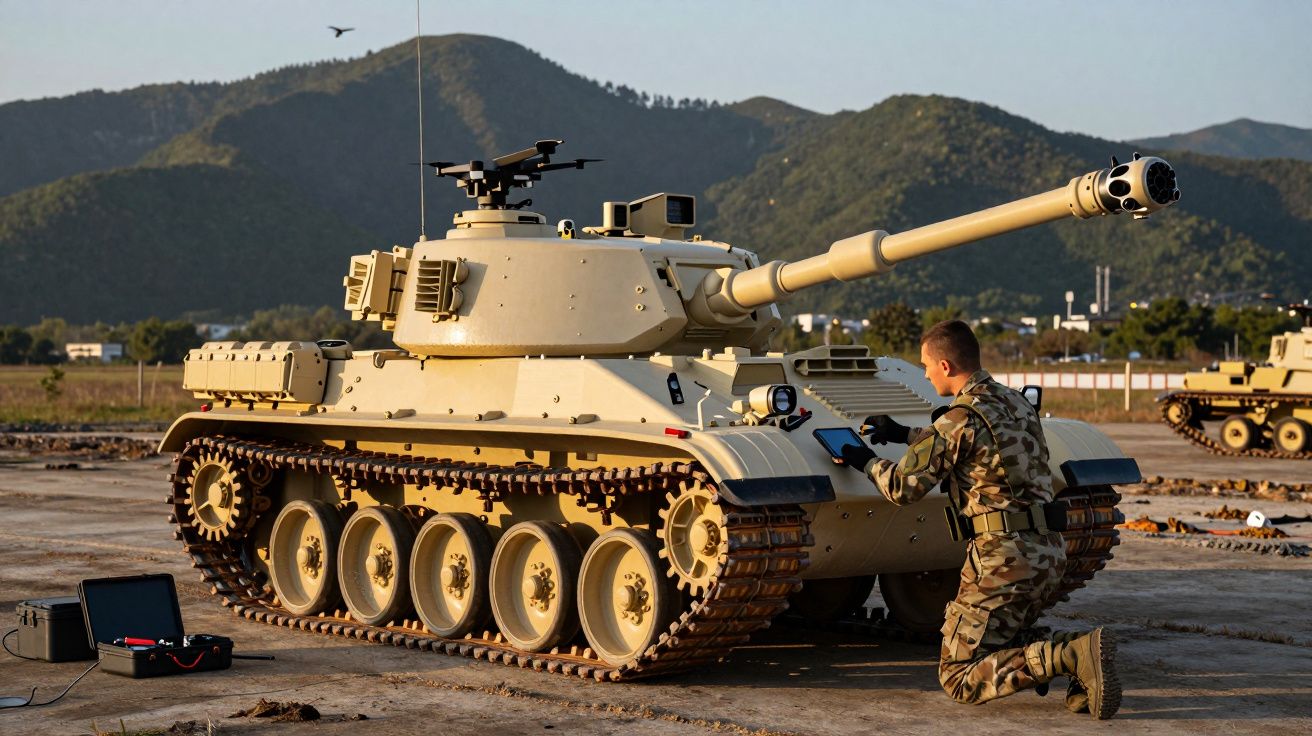
Far from the headlines, the French Army has been putting a radically upgraded Leclerc main battle tank through brutal, real-world trials. Fitted with a modular armour kit, anti-drone protection and reinforced anti-mine shields, this steel giant is being reshaped to face kamikaze drones, roadside bombs and RPGs rather than just enemy tanks. The goal: keep heavy armour relevant on battlefields where threats now come from every angle, any time.
Um laboratório de fogo real nos Alpes suíços
The setting could have passed for a postcard: snow-covered peaks around Hinterrhein, in the heart of the Swiss Alps. On the firing ranges below, it was anything but peaceful. The French Army’s 5th Dragoon Regiment rolled in with Leclerc XLR tanks, while Swiss forces lined up Leopard 2s for a joint exercise that was as much about the future of warfare as it was about training.
A França está a testar uma variante do Leclerc que troca peso bruto por uma proteção inteligente e modular contra drones, minas e foguetes disparados ao ombro.
Mountain warfare stresses machines in ways flatland training cannot. Steep slopes, narrow passes and unstable ground expose weak points in mobility, sensors and protection. That made Hinterrhein the perfect test lab for a new concept: a Leclerc wrapped in removable armour kits, designed not just to stop shells, but to survive the kind of cheap, agile threats seen daily in Ukraine, the Caucasus and the Middle East.
Um Leclerc vestido para a era dos drones
Among the French tanks on site, one stood out. It carried an experimental configuration combining several layers of passive protection:
- Grelhas e “gaiolas” metálicas para perturbar drones kamikaze e RPGs
- Blindagem reforçada na barriga e nas laterais contra minas e engenhos explosivos improvisados (IED)
- Blocos modulares adicionais que podem ser montados ou removidos consoante a missão
These additions are not decorative. Kamikaze drones can attack from above, where tanks have historically been less protected. Mines and IEDs strike from below, targeting tracks and crew compartments. RPGs often aim at flanks and rear. The French approach tries to create a protective “envelope” around the most vulnerable areas, while still letting the tank move and fight.
O Leclerc modernizado é menos sobre resistir a tudo e mais sobre poder ser configurado como uma caixa de ferramentas para cada ambiente específico de ameaças.
Uma filosofia modular em vez de volume permanente
Many modern tanks rely increasingly on heavy, permanent armour packages and active protection systems that fire interceptors at incoming projectiles. France is taking a slightly different path with this Leclerc XLR trial: flexibility first.
The protective kits are mechanical and modular. Crews and maintenance teams can mount or remove them depending on terrain, expected threats and logistics constraints. Urban combat? Fit full side skirts, anti-RPG cages and maximum mine protection. Open terrain with long-range engagements? Strip some modules to save weight and preserve speed.
This modularity is not just a technical nicety. It is a doctrinal statement: the French Army wants tanks that can shift roles quickly, rather than a one-size-fits-all monster that becomes too heavy and slow for many missions.
Atualizações tecnológicas já em curso
Since 2024, Leclerc XLRs have been receiving broader modernisation: improved sensors, digital networking systems and enhanced survivability features. The Hinterrhein exercise slotted into that wider programme.
French Leclercs faced Swiss Leopard 2s under live-fire conditions, with roughly 300 kinetic rounds fired over the course of the drills. This was not a competition of which tank is “best”, but a technical comparison of how different designs and doctrines respond to the same stress: contested European terrain under the shadow of drones, artillery and electronic warfare.
O sinal discreto da Europa sobre interoperabilidade
Switzerland may be neutral, but its ranges are ideal for multinational training. By testing a highly specialised French kit alongside Swiss vehicles, Paris is sending a message to its partners: these upgrades are not a national eccentricity. They are intended to plug into a broader European framework.
Interoperabilidade já não significa apenas usar a mesma munição: trata-se de partilhar conceitos de proteção, redes digitais e táticas adequadas a campos de batalha saturados de drones.
European armies are watching conflicts where commercial drones drop grenades, cheap loitering munitions hunt tanks, and artillery is guided by live video feeds. Any upgrade that keeps tanks survivable in that environment will draw attention from defence planners in Berlin, Rome, Warsaw and beyond.
De duelos de carros de combate a sobrevivência a 360 graus
The exercise showcased a shift in armoured doctrine. Tanks are no longer preparing solely for classic frontal engagements against other tanks. Instead, they operate in a lethal ecosystem of low-flying drones, concealed IEDs, roaming infantry teams with RPGs and long-range precision strikes.
That reality pushes armies towards a layered approach: passive armour, active jammers, smarter sensors and tight coordination with engineers and infantry. The French Army’s trials emphasise “resilience by design” – making sure that if one layer fails, another one catches the threat.
For tank crews, this means more complex training. They must learn to spot drone signatures on sensors, read electronic interference, and coordinate with anti-drone teams. They are no longer just gun crews; they are at the centre of a small, mobile protective bubble.
Logística e manutenção tornam-se mais complicadas
Modular armour has a cost off the battlefield. Every detachable kit brings storage needs, extra transport, fitting tools and specialised training. Units must plan not just for fuel and ammunition, but also which armour configuration they will require three days from now if the mission shifts.
Adaptar o Leclerc para uma máquina de guerra configurável empurra as unidades de logística e manutenção para um papel muito mais técnico e centrado em planeamento.
The French Army sees this as a worthwhile trade-off. A tank that can be quickly “re-skinned” for a different mission offers more flexibility for commanders. It also allows incremental upgrades: new anti-drone grills or improved mine plates can be rolled out as separate modules rather than waiting for a full vehicle overhaul.
Factos-chave dos testes em Hinterrhein
| Elemento | Detalhe |
|---|---|
| Data | 17 de novembro de 2025 |
| Local | Hinterrhein, Suíça |
| Unidades envolvidas | 5.º Regimento de Dragões (França), 17.º Batalhão Mecanizado (Suíça) |
| Munições disparadas | Cerca de 300 projéteis cinéticos |
| Tipos de carro de combate | Leclerc XLR, Leopard 2 |
| Módulos testados | Grelhas anti-drone, proteção anti-mina, blindagem modular |
Porque é que drones e minas assustam as tripulações
Drones and mines are not “high-tech” in the traditional sense, but they are proving brutally effective. Cheap quadcopters can act as spotters for artillery, loiter above treelines waiting for a tank to appear, or plunge into engine decks loaded with explosives. Even a modest blast in the right place can immobilise a multi-million-euro vehicle.
Mines and IEDs, meanwhile, undermine one of the tank’s great strengths: mobility. A disabled track can trap an entire column, giving enemy artillery or drone units time to finish the job. That is why reinforced belly armour, blast-deflecting shapes and better route-clearing tactics sit at the heart of the French trials.
O que “conflito híbrido” significa realmente para os carros de combate
The term “hybrid conflict” often gets thrown around without much explanation. In practical terms for tank crews, it means operating in an environment where conventional forces and irregular tactics are mixed together.
A Leclerc might face a professional armoured unit one day, then a patchwork of drones, militias and hidden IED belts the next. Cyberattacks can disrupt GPS or communications at the same time. This blending of threats demands vehicles that can cope with surprises, not just follow a cold war playbook.
The French approach in Switzerland hints at how heavy armour may survive this shift: by staying mobile, digitally connected and wrapped in a shell of adaptable, layered protection. The “steel monster” is changing shape, not stepping aside.



Comentários
Ainda não há comentários. Seja o primeiro!
Deixar um comentário